Illustrating difficult histories without taking sides
What I learned from drawing for Uncomfortable Oxford about illustrating contested pasts: raising questions rather than answering them.
Museums, universities and heritage sites are increasingly asked to address the uncomfortable parts of their history: empire, slavery, repatriation, who was commemorated and who was left out. Text can set out the evidence and the debate. Illustration is harder, because a drawing always takes a position, even when it isn’t meant to.
Most of what I know about this comes from my work with Uncomfortable Oxford, a social enterprise that runs tours about uncomfortable aspects of the city’s past. Their position was clear from the start: they want to generate discussion between people with different views, and to encourage people to listen to views they don’t share. The illustrations had to support that. They needed to draw attention to buried historical facts and make the viewer ask questions, without taking sides.
Questions, not verdicts
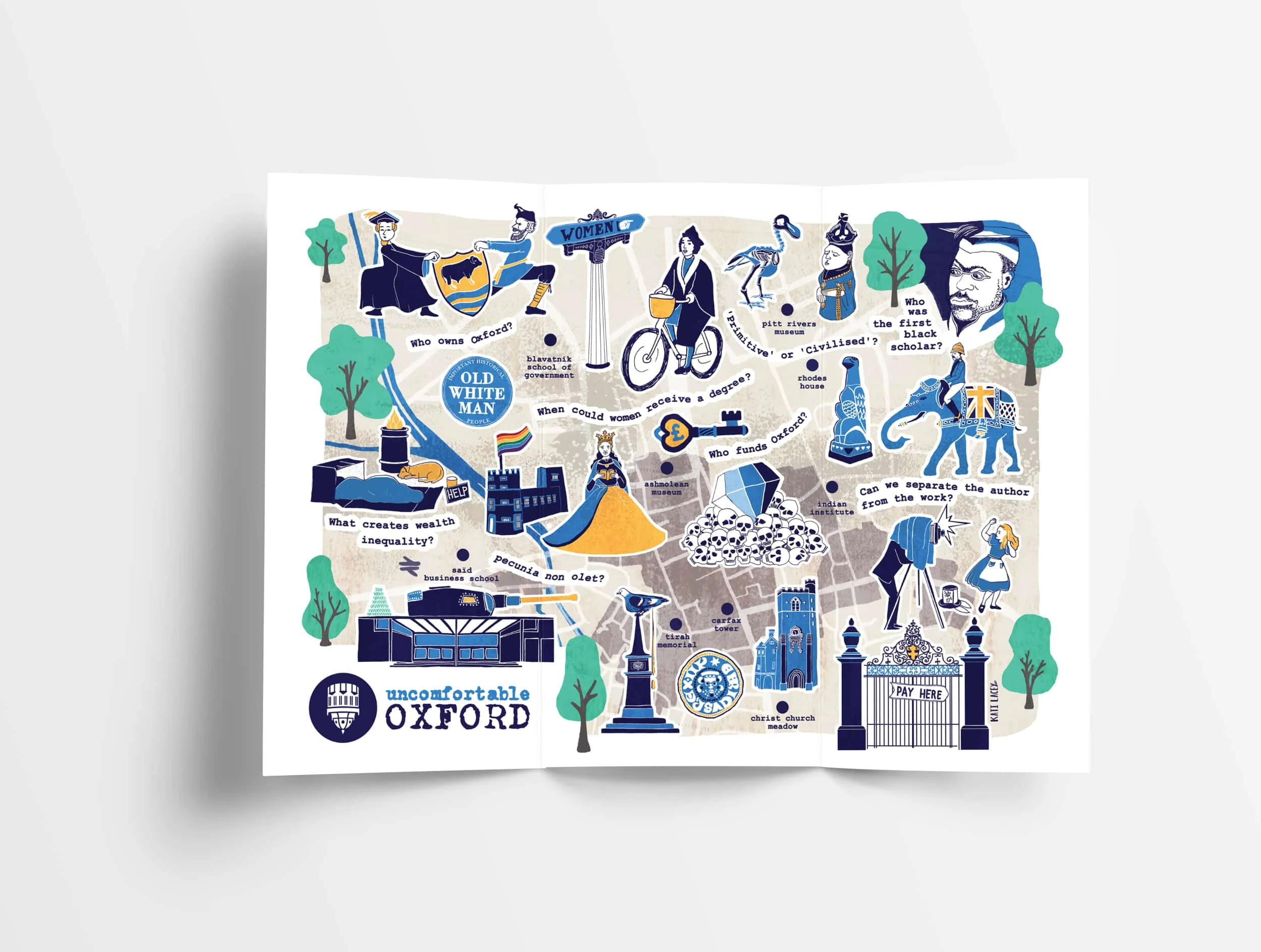
The clearest expression of that idea is the Uncomfortable Oxford map. Instead of a route from one landmark to the next, it is a map of questions. It highlights the themes the tours explore, some of which are still present in society today, and leaves visitors to make the connections themselves.
Drawing a debate
Some subjects are themselves a debate. The question of repatriation, which many museums now have to face and which Uncomfortable Oxford’s Ashmolean tour touches on, is a complex subject with many details. An illustration for an article about toppling statues had to show how values and ideals change over time, without celebrating or condemning any particular act.
In both cases the illustration works more like an opening question at the start of a discussion than a summary at the end of one.
What this means for a commission
If you are commissioning illustration on a contested subject, a few things help:
- Agree the organisation’s position first. Is the aim to present evidence, to prompt debate, or to acknowledge harm? The drawing will follow whichever it is.
- Involve the people whose history it is. Where communities are represented, their review of the roughs matters as much as a curator’s.
- Leave room for the visitor. Images that ask questions often do more than images that answer them.
- Expect to discuss the details. Small things, such as a facial expression, who is in the foreground or what is cropped out, carry meaning. They deserve time at the rough stage.
None of this makes illustration neutral. It does make it honest about what it is doing, and that seems to me the right standard for interpretation of any kind.

Illustrated interpretation
I work with museums, heritage organisations and research projects to create illustration that helps audiences understand the stories behind places and objects.